
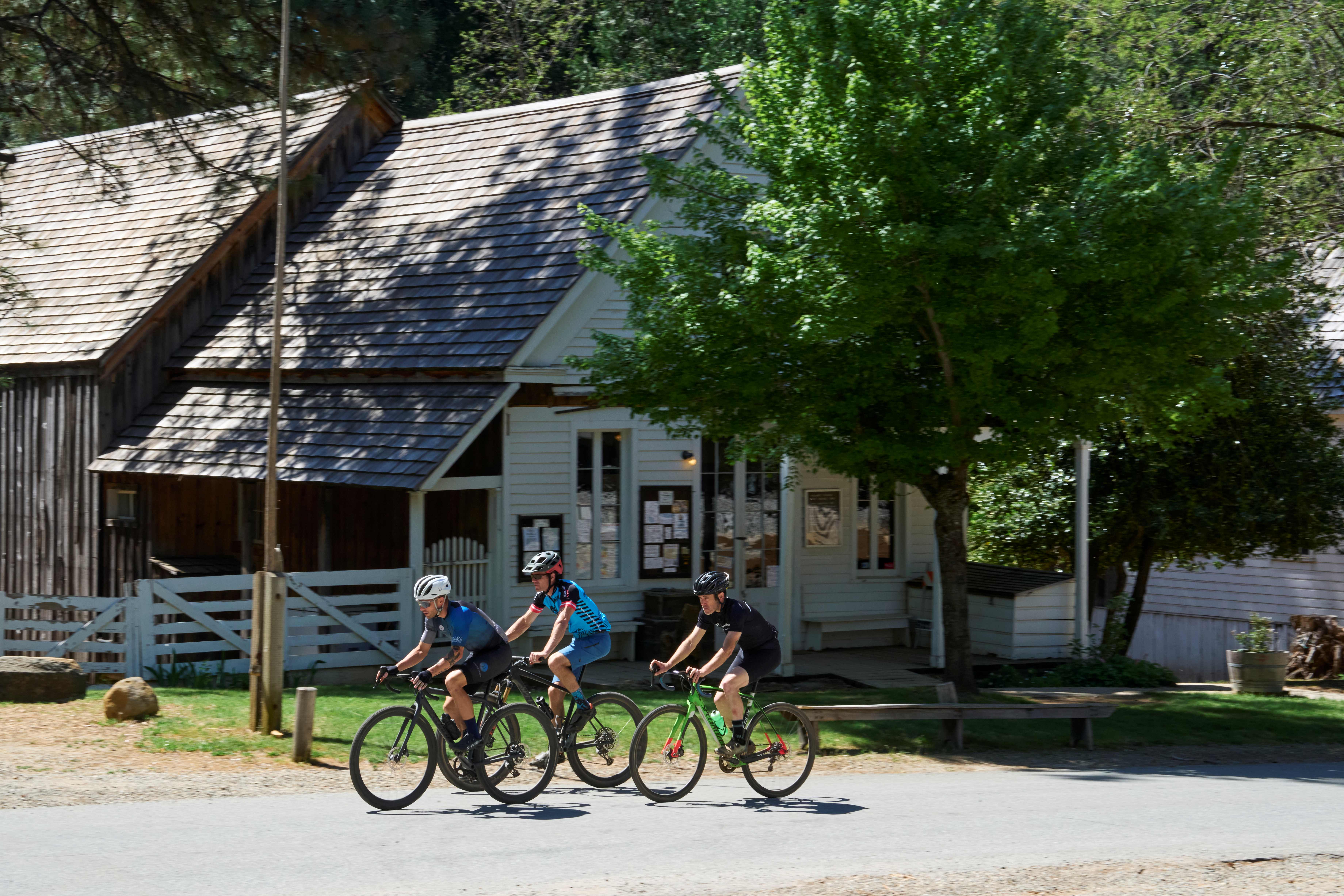
If you haven't read the Leg 1 Guide, we recommend starting there first. Leg 3 brings all three course options back together as riders journey through one of California's most remarkable Gold Rush landscapes. Here, history isn't confined to museums. It's etched into the hillsides, preserved in the buildings, and woven into every mile of road.
Leg Overview: Ghost towns, hydraulic mining history, and rolling gravel roads
Start Location: North Bloomfield
North Bloomfield: The Town That Refused to Disappear
After descending from the high country, Medium and Long Course riders arrive in North Bloomfield, one of the best preserved Gold Rush towns in California. Founded in 1851, it quickly grew into one of the state's richest mining communities thanks to the enormous hydraulic mining operations surrounding the town.
Unlike many mining camps that faded into history, North Bloomfield was preserved as part of Malakoff Diggins State Historic Park. Today, cyclists roll past the same general store, saloon, church, homes, and white picket fences that welcomed miners more than 150 years ago. During the summer, guided tours and living history demonstrations bring the town back to life, while the annual Humbug Days celebration fills the streets with period costumes, music, games, and Gold Rush reenactments.
Take a moment to slow down. You're riding through one of the most authentic windows into California's mining past.
Malakoff Diggins: California's Grand Canyon
Just beyond town lies the reason North Bloomfield existed in the first place.
Malakoff Diggins is home to the largest hydraulic mine in the United States. Beginning in the 1850s, miners used powerful water cannons to wash away entire hillsides in search of ancient gold bearing gravel. Over time, millions of cubic yards of earth disappeared, leaving behind towering cliffs, colorful canyon walls, and an otherworldly landscape unlike anywhere else in the Sierra.
The environmental impact was enormous. So much sediment washed downstream that it buried farms, clogged rivers, and contributed to one of California's most important court cases. In 1884, Judge Lorenzo Sawyer's landmark ruling effectively ended large scale hydraulic mining, changing the course of California mining forever.
Today, that once controversial landscape has become one of the state's most spectacular parks.
Rolling Back Toward Lake City
Leaving North Bloomfield, the course follows the winding North Bloomfield Graniteville Road back toward Lake City. Surrounded by towering pines and quiet forests, it's hard to imagine freight wagons, stagecoaches, and miners once traveled these same roads carrying supplies between booming mountain communities.
Back at the Lake City intersection, continue west on Lake City Road as the course gradually begins working its way toward the final leg of the race.
All Courses Reunite
Short Course riders rejoin the adventure after climbing Turnagain Arm from Grizzly Hill Road before turning onto Lake City Road. From here, all three routes follow the same rolling gravel roads toward North Columbia and the race's final chapter.
North Columbia
Today, North Columbia is a peaceful rural community, but during the Gold Rush it was another bustling mining camp serving the surrounding diggings. Like many Nevada County settlements, its fortunes rose and fell with the discovery of gold. As you pass through, it's another reminder of just how many thriving communities once dotted these hills.
The quiet roads and towering forests may feel timeless today, but nearly every ridge and creek you cross played a role in shaping California's Gold Rush.
This marks the end of Leg 3. Continue to Leg 4 as all three courses come together for the final miles back toward Nevada City, completing the Heart of Gold Gravel adventure.
There’s no better way to experience the Heart of Gold but by actually doing it. Click below to register for the upcoming race in October.